

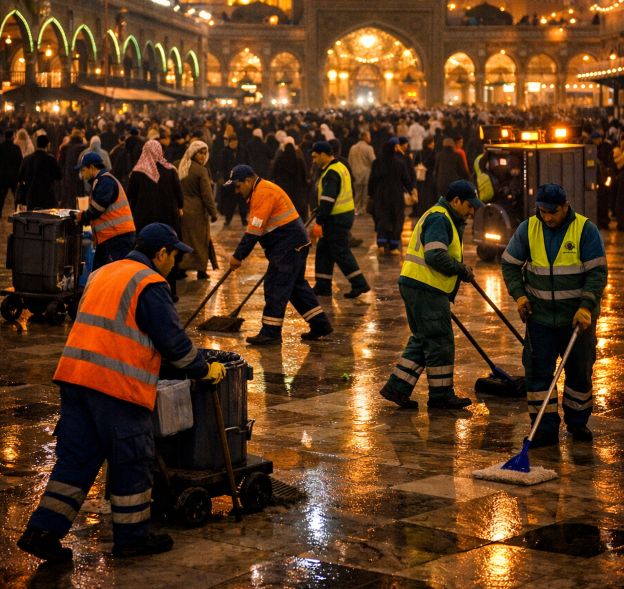
More than two million people gather in Mecca during the Hajj season each year, placing enormous pressure on transportation, sanitation, and public maintenance systems. Data from the Saudi Ministry of Hajj and Umrah and reports published by the World Health Organization have repeatedly highlighted how crowd management and hygiene practices play a central role in protecting public health in dense pilgrimage environments. In places where movement never fully stops, cleanliness becomes less of a background service and more of a carefully timed public operation.
Crowded sacred spaces create a unique challenge because they are designed for reflection and community while simultaneously handling the movement of thousands of people every hour. Floors must remain clean, waste must be removed quickly, and sanitation crews often work in narrow windows between prayer schedules and visitor flow. Discussions surrounding organized maintenance services, including resources such as Reliable home and apartment maintenance company (شركة صيانة موثوقة للمنازل والشقق), show how urban cleaning systems are increasingly expected to function with precision rather than simple routine labor. The growing complexity of these environments has changed the public understanding of maintenance work itself.
Why crowded environments demand precision
Large public spaces have always required maintenance, yet modern urban density has changed the scale of the challenge. Airports, train stations, stadiums, and pilgrimage centers now operate almost continuously. Sacred spaces face additional pressure because activity follows emotional and spiritual rhythms that cannot easily be interrupted for operational tasks.
Researchers from the International Journal of Environmental Research and Public Health have noted that sanitation quality directly affects visitor confidence and overall public safety in crowded environments. A delayed cleaning cycle in a heavily populated area can quickly lead to congestion, discomfort, and health risks. Unlike office buildings that empty overnight, sacred sites often remain active around the clock.
These conditions force cleaning crews to think differently. Workers cannot move randomly or independently. They must operate in coordination with security teams, transportation staff, facility managers, and crowd control officers. Timing matters as much as physical effort. One missed sequence can disrupt the entire system.
Despite the importance of sanitation, maintenance workers are often viewed as invisible contributors to urban life. Their labor becomes noticeable only when something goes wrong. Yet in highly populated environments, their role resembles operational management more than simple cleaning. Every action must fit into a larger rhythm.
Coordination challenges inside sacred spaces
Sacred environments present logistical difficulties that ordinary commercial spaces rarely face. People gather at predictable moments, but crowd intensity can shift within minutes. Cleaning pathways may suddenly become blocked. Waste collection schedules can change because of weather, transportation delays, or emergency protocols.
Experts from the United Nations Human Settlements Programme have emphasized that urban infrastructure systems function best when services are synchronized instead of isolated. Sanitation work in dense religious centers reflects this principle clearly. Crews often divide tasks into overlapping sequences, where one group clears pathways while another sanitizes surfaces and another manages waste transport.
The process resembles a chain reaction. If one team falls behind, pressure spreads throughout the system. A blocked entrance can affect pedestrian flow. Delayed floor cleaning can increase slip risks. Overflowing bins may create unnecessary crowding. Each task depends on timing and awareness of surrounding movement.
This operational structure explains why maintenance supervisors increasingly rely on predictive scheduling, route planning, and communication systems. Technology supports the work, yet human coordination remains the center of the process. Workers must react quickly while maintaining consistency in environments filled with noise, movement, and emotional intensity.
When sanitation begins to resemble musical performance
The comparison between sanitation work and ensemble music may seem unusual at first, yet the similarities become difficult to ignore in large public settings. An orchestra depends on timing, anticipation, and shared awareness. Individual performers follow separate parts while contributing to one coordinated outcome. Sanitation systems in crowded sacred spaces operate in much the same way.
Music scholars from institutions such as the Juilliard School and the Royal Academy of Music often describe ensemble performance as a balance between structure and adaptation. Musicians follow a score, but they constantly adjust to tempo changes, acoustics, and the movement of fellow performers. In a similar way, sanitation teams working in high-density sacred environments develop coordination that resembles trained vocal ensembles, where timing, breath, and responsiveness must align under pressure.
This perspective is also reflected in discussions on field practices such as professional cleaners’ vocal training analogy in Makkah, which highlights how disciplined repetition and rhythm shape both performance and cleaning precision. Maintenance crews experience a similar process when navigating shifting pedestrian traffic and changing operational demands.
A cleaning supervisor functions almost like a conductor. Workers move according to assigned timing while remaining alert to sudden disruptions. Communication becomes subtle and continuous. Visual cues, radio updates, and route adjustments replace musical notation, yet the underlying principle remains coordination through shared rhythm.
The comparison grows stronger during periods of peak movement. In musical ensembles, one delayed section can disrupt the balance of the entire performance. In sanitation systems, one interruption can affect safety and efficiency across an entire facility. Success depends less on individual speed and more on collective synchronization.
There is also a psychological dimension to this parallel. Research from the Harvard Business Review has explored how synchronized teamwork improves trust and reduces operational friction in high-pressure environments. People working in rhythm often develop stronger awareness of collective goals. In sanitation work, this shared timing helps crews maintain calm and consistency even under exhausting conditions.
Lessons for maintenance systems in dense cities
The challenges seen in sacred spaces increasingly mirror conditions in fast-growing urban centers. Cities worldwide are becoming more crowded, more active, and more dependent on uninterrupted public services. As a result, maintenance strategies built around isolated tasks are gradually giving way to systems focused on coordination and flow.
Urban planners now recognize that sanitation affects more than appearance. Clean environments influence mobility, public confidence, tourism, and health outcomes. Reports from the Organisation for Economic Co-operation and Development have linked reliable public maintenance systems with stronger urban resilience and improved quality of life.
This shift has encouraged greater investment in integrated maintenance planning. Some cities now coordinate cleaning schedules with transportation data and pedestrian traffic analysis. Others use real-time monitoring to identify areas requiring immediate attention. The objective is not constant cleaning for visibility alone. The goal is stability, efficiency, and reduced disruption.
These systems also highlight the importance of dependable property care providers and organized residential service networks. In dense communities, apartment upkeep and residential sanitation contribute directly to broader urban health standards. Well-managed housing environments reduce pressure on public infrastructure and support cleaner shared spaces.
At the same time, the conversation should remain balanced. Technology and coordination can improve sanitation systems, yet they cannot replace fair labor conditions or human judgment. Maintenance workers still carry the physical and emotional demands of operating in crowded spaces. Public discussions about urban cleanliness should therefore include recognition of the people performing the work behind the scenes.
Cleanliness as a form of civic rhythm
High-traffic sacred spaces reveal something important about modern cities. Cleanliness is rarely achieved through isolated effort. It emerges from coordination, timing, communication, and trust between people performing interconnected tasks. The process resembles choreography because every movement affects another.
Viewing sanitation work through the lens of ensemble performance changes the way these systems are understood. Maintenance becomes more than routine labor. It becomes a structured response to movement, density, and public expectation. The rhythm behind the work is often invisible, yet its impact shapes how people experience shared environments.
As urban populations continue to grow, cities may increasingly adopt maintenance models built around synchronization rather than reaction. Reliable property upkeep services, organized residential maintenance providers, and coordinated public sanitation teams will likely become central parts of urban planning conversations. The future of cleanliness in dense environments may depend less on isolated cleaning actions and more on how effectively entire systems learn to move together.